

You’re reaching into the garage for a box, moving a pot in the garden, or sweeping out the corner of a shed, and something dark and glossy catches your eye. Could that be a black widow? In California, that’s always a possibility. Black widows are among the scariest and most threatening spiders in the state, and encounters happen more often than most homeowners expect.
The good news is that black widows are actually one of the easier spiders to identify once you know what to look for. The challenge is that several other California species share a similar deep-colored, round appearance, making it easy to confuse a dangerous spider for a harmless one. This guide from the experts at Dewey Pest and Termite Control will explain how to spot a Western black widow, how it compares to its most common lookalikes, and what to do if you find one.
What Is a Black Widow Spider?
Black widows belong to the genus Latrodectus, a group of venomous spiders found on nearly every continent. In California, the species you’re most likely to encounter is the Western black widow (Latrodectus hesperus). Its venom contains a neurotoxin that can cause serious symptoms requiring medical attention, though black widow bites are rarely fatal for healthy adults. Knowing what this spider looks like (and what it doesn’t) is your first line of defense.
Where Black Widows Live
The Western black widow thrives in warm, dry, undisturbed environments, which can be easily found across the Golden State. They gravitate toward low-light, sheltered spots where they can build irregular webs close to the ground. Common locations where California black widows are found include:
- Garages, sheds, and outbuildings.
- Woodpiles and lumber stacks.
- Under rocks, debris, or dense ground cover.
- Crawl spaces and basement corners.
- Southern California (Los Angeles, San Diego, Santa Monica).
- The Central Valley (Fresno, Bakersfield, Modesto).
- Desert regions (Palm Springs, Lancaster, Victorville).
- Northern California (San Francisco, Sacramento, Walnut Creek).
What Do Black Widow Spiders Look Like?
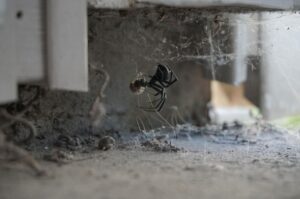
Black widows aren’t especially large, but they have a precise combination of body shape, color, and markings that is hard to forget once you’ve seen it. The features below describe the adult female Western black widow, which is the sex responsible for medically significant bites and the one homeowners are most likely to encounter.
Body Shape and Size
The adult female has a plump, distinctly rounded abdomen, often compared to a small, glossy bead. This globe-like shape is the most immediately striking feature, noticeably large relative to the rest of the body. The front section of the body is much smaller and flatter, giving the spider a pronounced top-heavy silhouette.
Leg Structure
Black widows have eight long, slender, smooth legs that look almost delicate compared to the bulbous abdomen. One useful behavioral clue is that black widows often hang upside down in their webs, naturally exposing the underside of the abdomen. Conveniently, this is right where the most important identifying feature is found.
Color and Markings
The adult female Western black widow is jet black and intensely glossy, almost lacquered-looking. This deep, uniform color covers the entire body and legs. Juvenile females and males may show orange or yellowish markings that fade with maturity, leaving the adult female essentially solid black. When combined with her body shape, this makes her one of the more recognizable spiders in North America.
Iconic Red Hourglass
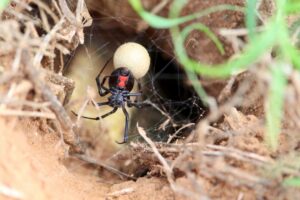
Observe a black widow hanging upside down and you’ll see what makes this spider famous: a vivid red hourglass marking on the underside of the abdomen. On the Western black widow, it’s bright red or orange-red, clearly defined, and shaped like two triangles meeting at a narrow center point. This is the single most reliable identification feature. If you see it, don’t reach for the spider. Reach for your phone to call for help.
Brown Widow vs Black Widow
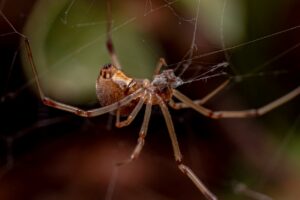
The California brown widow spider (Latrodectus geometricus) has spread widely across the region and is one of the most common sources of misidentification. It shares the classic widow body shape and prefers similar habitats like garages, fences, and outdoor structures. A closer look reveals clear differences between black and brown widow spiders in California:
- Color. Brown widows are tan to dark brown with a mottled, banded leg pattern. Black widows are solid, glossy black.
- Hourglass. Brown widows have an orange-to-yellow hourglass, not the signature red mark that black widows have.
- Egg sacs. Brown widow egg sacs are spiky and textured. Black widow egg sacs are smooth and round.
- Dorsal markings. Brown widows show a geometric pattern on top of the abdomen, while black widows are solid black on top.
| Feature | Brown widow | Black widow |
|---|---|---|
| Color | Tan to dark brown with a mottled, banded leg pattern | Solid, glossy black |
| Hourglass marking | Orange to yellow | Bright red |
| Egg sacs | Spiky and textured | Smooth and round |
| Dorsal markings | Geometric pattern on top of the abdomen | Solid black on top |
Are Brown Widows Dangerous?
Yes, and this often gets overlooked. Brown widow venom is generally considered less potent than that of a black widow, but a brown widow bite can still cause pain, swelling, and muscle cramps. Their rapid spread across Southern California means they’re increasingly common in backyards and around outdoor furniture. So while you may feel relieved at first that you don’t have a black widow on your property, it’s still a problem to take seriously.
Other Black Widow Lookalikes
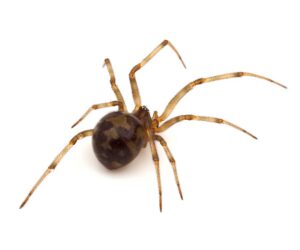
Several other dark-bodied spiders in California can cause homeowners to do a double-take, particularly if they’ve never seen a black widow up close. Most are harmless, but misidentifying a real black widow is a risk not worth taking. Below is a look at what spiders are most commonly mistaken for black widows.
Cupboard Spiders
The cupboard spider (Steatoda grossa) is the most frequent black widow lookalike found indoors. It shares a rounded abdomen, dark coloration, and a preference for quiet corners, but lacks the trademark red hourglass. Its color tends toward dark brown or purplish-black rather than glossy jet black. Cupboard spiders are harmless and actually help control other insects.
Noble False Widow
The noble false widow (Steatoda nobilis) has a bulbous abdomen and dark coloration, but typically displays cream or brownish markings on top of the abdomen. Non-native to California, it has been expanding its range to the west coast. Its bite can cause localized pain, but it’s far less dangerous than a true black widow.
Triangulate Cobweb Spiders
The triangulate cobweb spider (Steatoda triangulosa) is smaller than a black widow and marked with a reddish-brown triangulated pattern on a purplish or brownish abdomen. It builds irregular cobwebs in corners and undisturbed spaces and is completely harmless. Its smaller size, warmer coloring, and visible dorsal pattern distinguish it clearly from a black widow.
What Do You Do If You See a Black Widow Spider?
If you spot a black widow, do NOT touch it. Get children and pets far away immediately, and resist the urge to disturb the spider or its web, as a threatened black widow will bite. Move calmly away, close off any exits if indoors, and note the location for treatment.
One black widow doesn’t necessarily mean a major infestation, but it does signal that conditions in your home are welcoming to them. Where there’s one, others may not be far behind. Your safest option is to contact the professionals at Dewey Pest and Termite Control rather than attempt to handle it yourself.
Professional Pest Control for Black Widows
Store-bought sprays may eliminate the spiders you can see, but they won’t address harborage areas, egg sacs, or the conditions that attracted them in the first place. Dewey’s professional spider control services in California use treatments that are harmless to humans and pets while targeting black widows at every stage of their lifecycle, including egg sacs that most homeowners never find on their own.
Expert Black Widow Spider Pest Control From Dewey
Don’t let a black widow problem go unaddressed. With almost 100 years of experience protecting California homes and businesses, Dewey Pest & Termite Control has the expertise to identify warning signs and implement black widow spider control the right way. We offer options across the state, including spider control in Modesto, CA, and spider control in Walnut Creek, CA.
Get started right away! Contact us today or find your local pest control team to schedule your free consultation and take back your space with confidence.